The World He Ruled
The Roman Empire in 180, the year he died. Scroll or pinch to zoom; drag to move; double-click to close in.
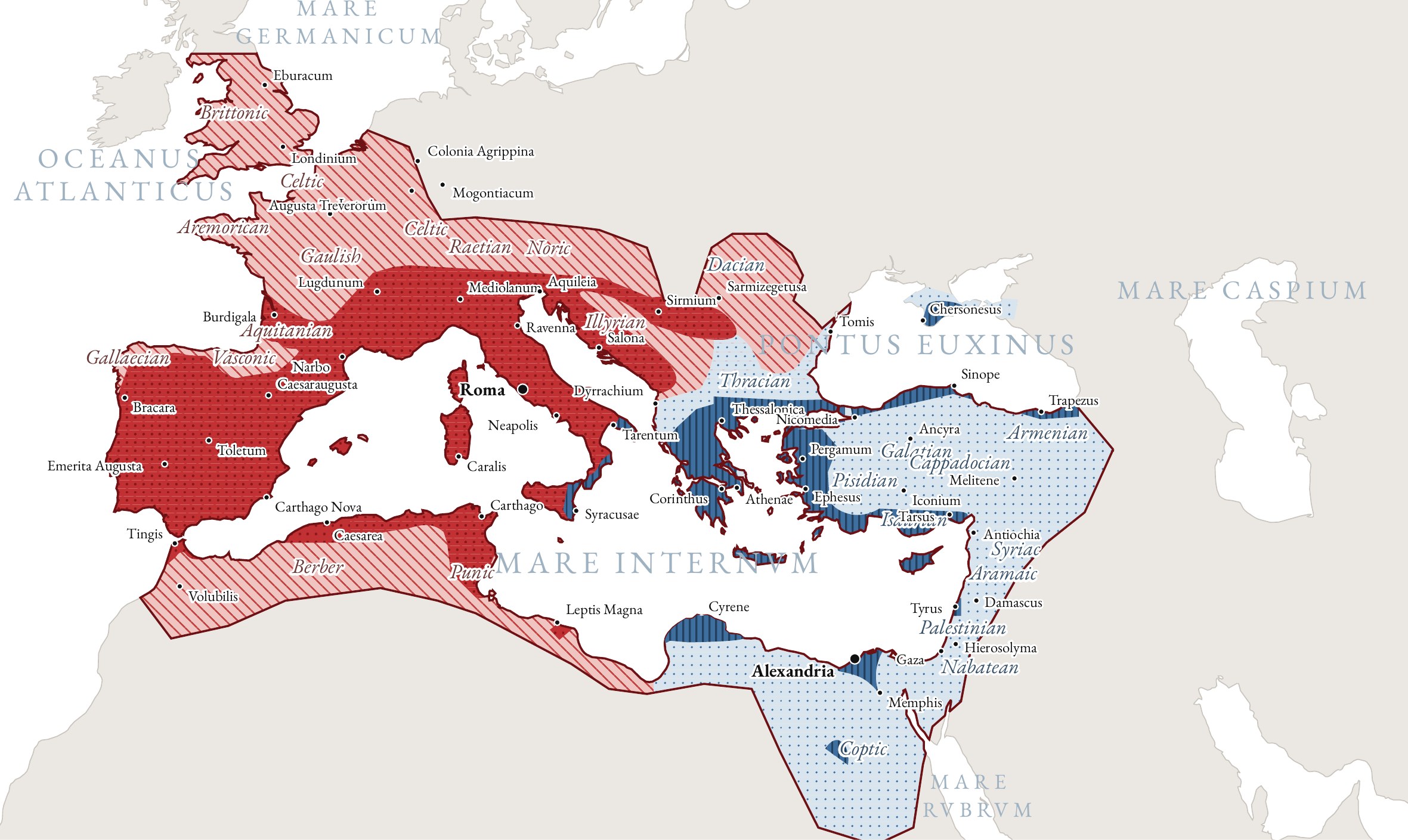
The map that stands here in the printed book shows the empire as it was in the year 180, the year he died. Picture it. From the wall Hadrian built across northern Britain, south through Gaul and Spain to the Atlantic, along the whole rim of North Africa from Morocco to the Nile, up through Egypt and Judaea and Syria to the Euphrates, across Asia Minor and Greece, and north again to the Danube and the Rhine: one government, one law, one coinage, around an inland sea that Romans could call, without boasting, our sea. Something near sixty million people lived inside that line, speaking a hundred languages under two official ones. Thirty legions held the edges of it, and most of the fighting in his reign was on the Danube, where he was.
Rome did not rule the way empires are imagined to rule. When a territory came under the eagle, its gods stayed in their temples, its markets kept their tongues, and its local men of standing kept their standing, now with Roman backing. What Rome asked for was tribute, soldiers, and loyalty; what it offered was roads, law, water, and peace. For millions, the bargain was better than what it replaced, and that, more than the legions, is how one city held the world for centuries. Where the bargain was refused, Rome could be merciless: Carthage, Corinth, Judaea. But its default was absorption, not erasure.
That was the result. Two languages of power — Latin in the West, Greek in the East — laid over an empire that never demanded its peoples stop being themselves: beneath the official tongues, Gaul still spoke Gaulish, Egypt still prayed in Egyptian, Syria in Aramaic. Marcus ruled the whole of it. And when he sat down at night to write to himself, this Latin emperor wrote in Greek.
The map is the book's own, drawn for the hardcover. Place names are given in Latin as the Romans wrote them; the sea in the middle is Mare Internum, the inner sea, which the Romans also called, without boasting, our sea.