His Life in Time
Marcus Aurelius, 121 to 180. Sixteen moments, in order, from his birth to his death. Choose a year, or use the arrow keys; drag the rule to move along it.
All sixteen, in order
121 Born in Rome
Born Marcus Annius Verus, the twenty-sixth of April, into a rich senatorial family. His father died when he was a small boy. The emperor Hadrian noticed him early and called him Verissimus, truest. The seriousness showed early: by twelve he had taken up the philosopher’s rough cloak and was sleeping on the ground, until his mother talked him onto a couch.
138 Adopted Into the Succession
Hadrian, dying, named Antoninus Pius his heir, on the condition that Antoninus adopt the sixteen-year-old Marcus in turn. The empire was settled over his head, and a twenty-three-year apprenticeship began. He spent it at Antoninus’s side, watching how a man could hold absolute power and stay plain. That watching became the longest debt in Book One. Book One, entry sixteen.
145 Marries Faustina
Faustina the Younger, the emperor’s daughter and his own cousin. They were married for thirty years, had at least thirteen children, and buried most of them. Rome gossiped about her for centuries; his notebooks only thank the gods for her. Book One, entry seventeen.
c. 146 Philosophy Claims Him
Around twenty-five he was reading the Stoics; at some point in these years Junius Rusticus put the Discourses of Epictetus into his hands, the debt Marcus records in Book One. His letters to Fronto, his rhetoric master, show the change as it happened: Rome’s most promising orator quietly defecting to philosophy. Book One, entry seven.
161 Becomes Emperor
On Antoninus’s death, Marcus refused to rule alone and had the Senate raise Lucius Verus beside him, the first time Rome had two emperors. The same year, war with Parthia opened in the East. He was thirty-nine, and had been heir for twenty-three years without once forcing the pace.
166 The Plague Reaches Rome
Verus’s armies came home from Parthia carrying the Antonine plague, probably smallpox, which burned through the empire for years and killed on a scale Rome had never seen; some estimates put it at a tenth of the empire. It stalked the army camps where Marcus would spend the rest of his life.
167 The North Breaks Open
The Marcomanni and the Quadi crossed the Danube, and within three years stood before Aquileia, the first enemy army inside Italy in more than two and a half centuries. This is the war the notebooks were written inside, and it would consume nearly all the years Marcus had left.
168 First Journey North
Marcus and Verus rode out of Rome together in the spring, crossed the Alps, and made their headquarters at Aquileia. It was the first war he had ever seen with his own eyes. The plague followed the army into winter quarters, and on the road back in the new year Verus was dead.
169 Lucius Verus Dies
With Verus gone, Marcus was alone at the head of an empire at war, and he would spend most of the rest of his life in camp, not in Rome. From here the geography of the Meditations is fixed: a camp bed, a lamp, the Danube in the dark.
c. 170 The Notebooks
Somewhere in these campaign years, by lamplight, he began the private notes he never titled and never meant anyone to read. Book Two signs off: among the Quadi, on the River Granua. Book Three: at Carnuntum.
172 The Rain
Deep in the country of the Quadi, a Roman column was surrounded and dying of thirst in the heat when a storm broke over the battlefield. The Romans drank from their shields and the lightning fell on the enemy. Everyone claimed the miracle afterward, the Christians for a praying legion, the pagans for a magician, the Senate for the emperor’s piety. The column in Rome shows the rain god himself, spreading his arms over the soldiers.
175 The Revolt of Avidius Cassius
His best general in the East proclaimed himself emperor on a false report that Marcus was dead. The revolt collapsed in three months; Cassius was killed by his own officers. Marcus, it is said, had his correspondence burned unread. He marched east anyway to steady the provinces; Faustina, traveling with him, died on the road. He had her deified, and named a town for her.
176 The Triumph, and the Chairs
Back in Rome, Marcus celebrated the triumph with Commodus at his side. The same year he endowed four chairs of philosophy at Athens: Platonic, Aristotelian, Epicurean, and Stoic. The emperor who wrote philosophy by lamplight in a war camp made it a public institution of the empire.
177 Commodus Made Co-emperor
The succession settled on the only son he had left: Commodus, raised to co-Augustus at fifteen. The next year, father and son left for the Danube together. History judges the choice harshly; Marcus had no other sons left to choose, and the philosophy itself is blunt about what lies outside your control.
179 Beyond the River
In his last winter, eight hundred and fifty-five men of the Second Legion camped at Laugaricio, deep in the country of the Quadi and a hundred kilometres north of the Danube, the farthest Rome is known to have stood in that direction. They cut the record into the rock above what is now Trenčín, in Slovakia, and it is still there. Marcus was not holding a line. He was moving it.
180 Dies on the Frontier
The seventeenth of March, in a frontier camp — at Vindobona, modern Vienna, though some sources say Sirmium — aged fifty-eight. His last recorded words, to the night watch: go to the rising sun; I am already setting. No one knows who saved the notebooks, or how. They passed hand to hand for eighteen centuries to reach this page. Book Twelve, entry thirty-six.
The plate as printed
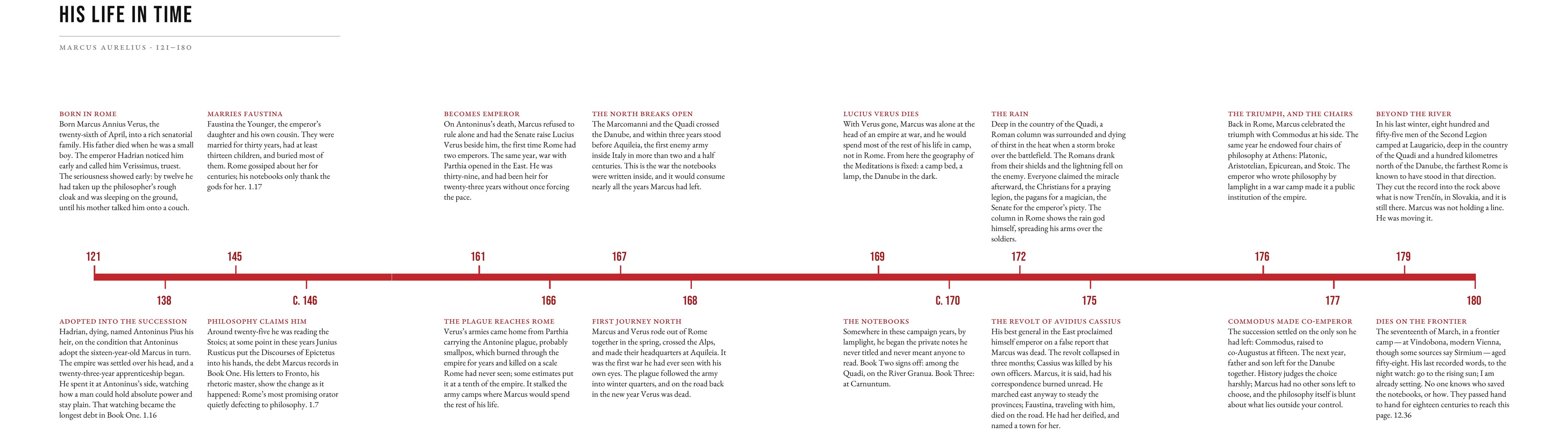
Four pages of the hardcover, set end to end. The years sit above and below the rule and read left to right.